
A Day in the Life of an Archaeologist in Egypt
What does an archaeologist actually do? Let me give you a behind-the-scenes look. It is not all Indiana Jones and punching Nazis, it’s not even dusting off bones with tiny brushes (well only sometimes). It often does involve a fair bit of tromping around the desert. Spend a day in the life of an archaeologist with me as I do some field research in Egypt.
I’m Dr. Beth Hart and I’ve been doing archaeology in Egypt for over 20 years. Learn more about me here.
Chasing Stone Tools: What an archaeologist in Egypt actually studies
Stone tools are not always Stone Age tools. I study ancient economies, supply chains if you will, focusing on ancient stone tools. Even during the time of the pharaohs, well after the stone age, stone tools were quite important for daily life, used in making food (think butchering meat, scaling fish, harvesting grain), wood working, leather working, even making stone vessels and probably statues. Egypt has stone everywhere, but it is not all of the same quality, and not everyone had the skills needed to make the stone tools. So by finding the places where stone was quarried and where the tools were made I can understand a bit more about ancient Egyptian society and economy, how it changed over time, and how similar or different it was in comparison to other places and times.
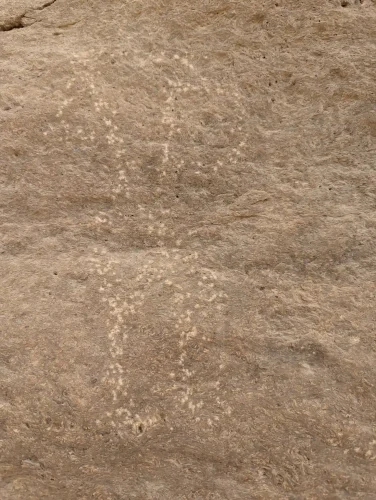
Rock Art and Rocks: Are they related?
I came out to this site because other archaeologists had found a lot of remains of stone tool production in front of rock art sites. So I wanted to understand if ancient Egyptians were getting the stone for the tools out there, and if the stone tool production happened at the same time as they were making the rock art, or if they were unconnected. Some of the rock art is quite delightful, depicting animals like giraffes, elephants, and ostriches that used to live in the area when it was less dry.
Off the Beaten Path: Getting to a desert archaeology site in Egypt
Although I spend most of my time in a storage room analyzing the artifacts themselves, I need to understand the geological and landscape context of where they are coming from- hence the day out in the desert.
The sites were far into the desert, so we had to take a sturdy vehicle and endure a bouncy hours-long ride each way. I will never understand how I can get carsick being in an Uber for 5 minutes, but these jarring desert excursions are just fine. Maybe it’s the suspension. Maybe it’s the fresh air.
Note that I’m not going to say exactly where this is to help protect the site from looters. Because they are so remote Rock art and stone tool scatters like these are usually unguarded, so archaeologists share locations with the Egyptian authorities, not publicly.
Geological sleuthing: where did the chert for the stone tools come from?
Once there, before even looking at the find sites themselves, I was studying the geology and landscape. There were gravel boulders of all different sizes, from fist sized to bigger than a bowling ball, all over the ground surface (hence the bumpy ride!). But looking at the actual stone outcrops in the area, there were some chert (flint) nodules coming out, but they were much smaller. I then broke open some of the nodules from the outcrops and some of the nodules from the ground surface. Though both contained chert, the quality and sizes were different. It seems likely that the gravel on the surface is either a natural gravel deposit (like a layer among the other types of stone) or the gravels had been washed down the wadi, rather than having eroded out of the nearby outcrops.
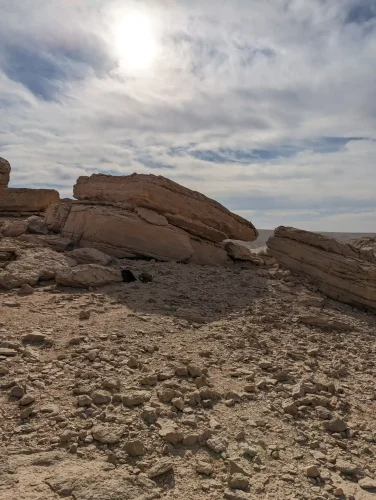
Size Matters: Matching artifacts to nodules
The sizes of the nodules from the outcrops were too small compared to the artifacts I had seen, but the nodules on the surface were certainly big enough and had similar characteristics as the artifacts, so it seems likely that the ancient people making stone tools here simply used the surface cobbles, rather than trying to extract nodules out of the larger outcrops. One mystery solved.
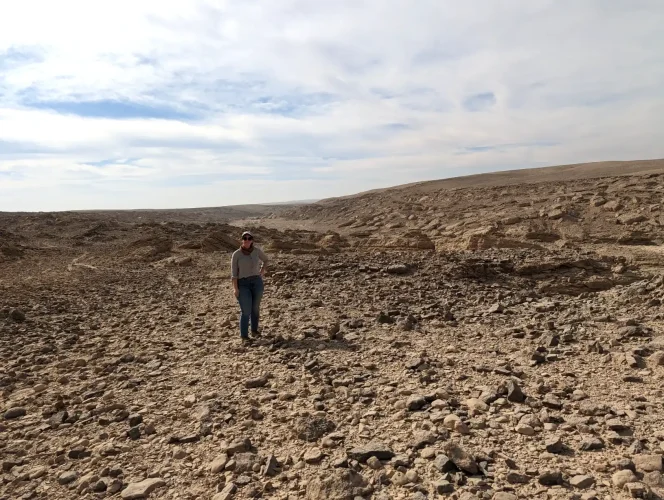
Enjoying the Desert Landscape, for Science: Assessing site formation
Second I needed to understand if the accumulations of artifacts in front of the rock art panels was accidental – like from movement by rain, wind erosion, etc. – or from human activities. That was why we looked at not only the rock art sites themselves, but all around including the high desert plateau above. You can imagine I was so sad to have to hike all around and take in some beautiful views (when I remembered to look up at least!).
We could easily see that although there would be a stray artifact here and there (like the scraper I show in the video), the artifacts were very clearly concentrated around the rock art panels, likely due to the actions of ancient people rather than nature.
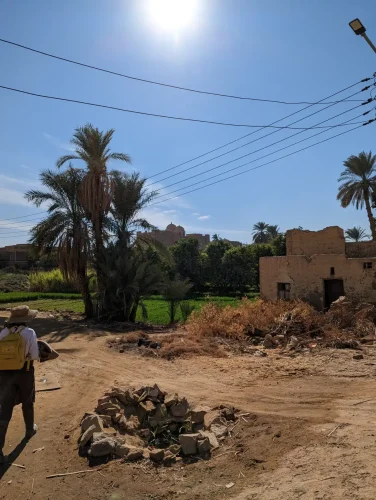
Never a Dull Moment in Egypt: Car breakdown
After far too short a time we had to start the trek back- bouncing back the way we came. The car apparently wasn’t too happy about it either because when we were almost back to the dig house it broke down. Luckily it was close enough to walk back, so we strolled through the village streets and took a shortcut through some farm fields that felt very lush after a day in the desert sand.
What do you think?
Is that what you expected a day-in-the-life of an archaeologist to be like?
Leave a comment below!
Want to Visit Egypt?
I love sharing Ancient Egypt with people by helping them visit Egypt! While I can’t take you to these sites in particular, I can help you plan an amazing trip, or you can join one of the curated small group tours that I lead. Find out more information here: