Top 5 Grand Egyptian Museum Highlights Not To Miss
Grand Egyptian Museum Hidden Gems
The Grand Egyptian Museum in Cairo is the largest museum in the world dedicated to a single culture, in this case Ancient Egypt. With over 100,000 artifacts in the collection, there is a lot to see, and most people only go for a few hours! Let me help you find the top 5 hidden gems not to miss at the Grand Egyptian Museum.
Most people visit the Grand Egyptian Museum with a tour guide who will take you around for a few hours, then give you some time to look around on your own. Whether you go with a guide or on your own, you will definitely see the museum’s top highlights, like Tutankhamun’s mask and royal throne, Khufu’s solar boat, the colossal statue of Ramses II, and the grand staircase with statues of famous pharaohs like Hatshepsut and Akhenaten. But there are so many more amazing pieces to see!
I was there accompanying a group as an archaeology expert, and after our Egyptian tour guide finished and gave everyone some time to look around on their own, one of the members turned to me looking a bit overwhelmed and asked “What shouldn’t I miss?” That inspired me to write this post and share my favorite highlights that you might miss, but shouldn’t.
Your Archaeologist Guide to the Grand Egyptian Museum
I’m Dr. Beth Hart and I have been doing archaeological research in Egypt for over 20 years, working at sites like Giza, the Valley of the Kings, Abydos, Aswan and many more. The Grand Egyptian Museum has been in the works for most of that time, so I was pretty excited when the museum finally opened!
I also lead trips to Egypt, so if you would like to travel Egypt with an archaeologist, check out my website and upcoming tours. I can also help you plan your own trip or give you advice on an itinerary. For now, read on or watch the video below while I take you on a virtual tour of the Grand Egyptian Museum by showing you my top 5 highlights not to miss!
1- Hierakonpolis Tomb 72: The Beginnings of Royalty in Ancient Egypt
Before Tutankhamun there was the owner of Tomb 72 at Hierakonpolis. Like way way before. Around about 4000 BCE people were just starting to take up farming in the Nile Valley and living more sedentary lives. By 3000 BCE we have kings ruling over a united country stretching from the Mediterranean Sea to the 1st cataract at Aswan. How did that happen?! The site of Hierakonpolis and finds like Tomb 72 give us some clues.
Hierakonpolis is one of the earliest sites in Egypt where we can see the development of social stratification. There is a cemetery near the settlement (cemetery HK43) with a lot of simple graves and few artifacts, and then there is a separate cemetery, (cemetery HK6) a little ways into a desert valley far back from the settlement. It was fenced off and the tombs are larger, many have structures built on top of them, some people surrounded themselves with burials of wild desert animals, and there are columned halls built of wood and reeds where the team excavating at Hierakonpolis has uncovered offerings left in the corners of these buildings. You can learn more about Hierakonpolis at the excavation’s website https://hierakonpolis-online.org/
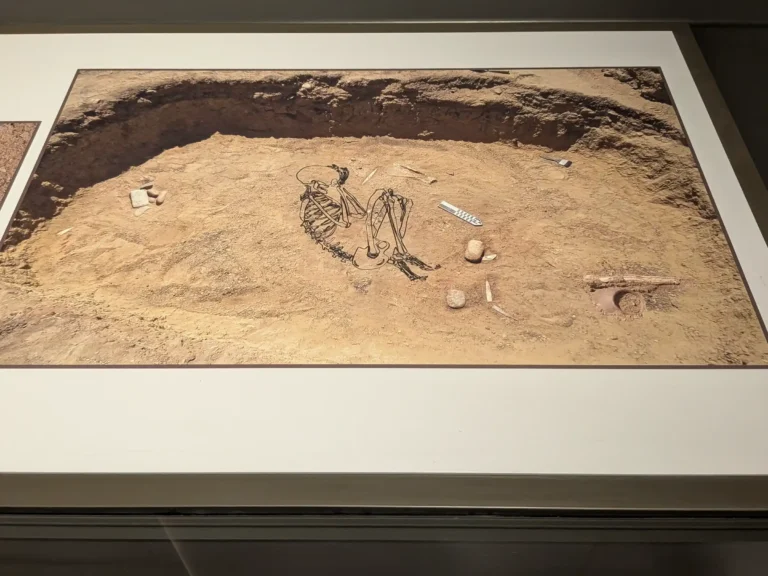
Tomb 72 part way through excavation with many grave goods still in place, and a drawing of the likely position of the body.
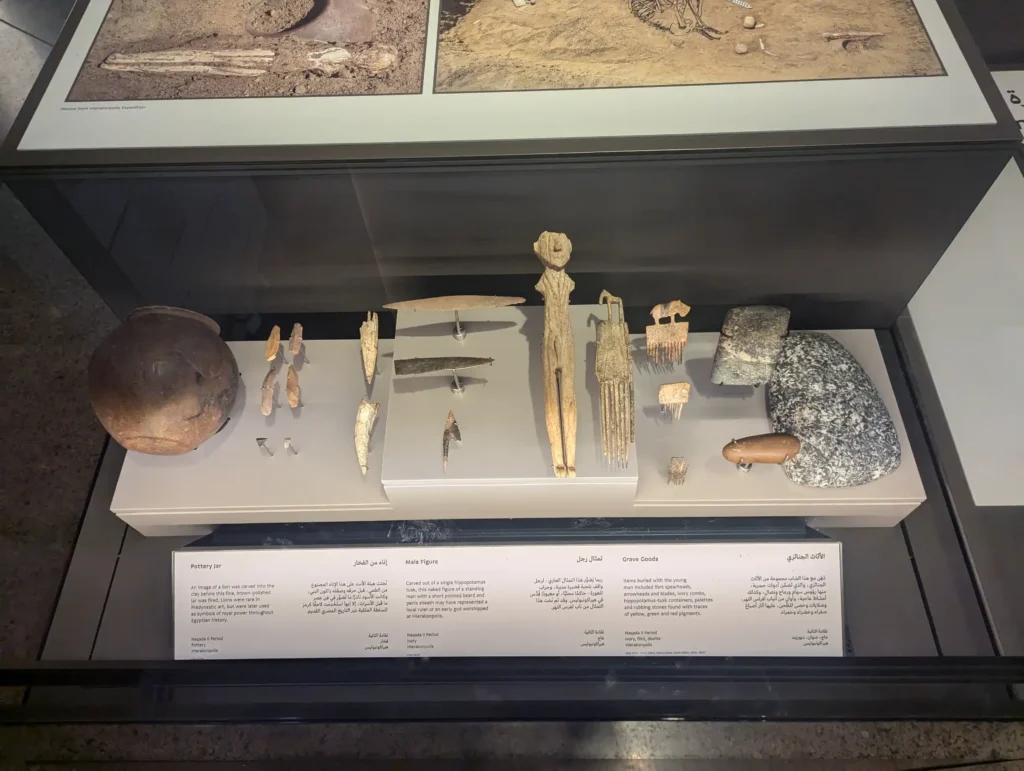
The grave goods found in Tomb 72 include (from left to right): a pottery vessel with the silhouette of a lion; 6 flint tools including two small arrowheads; two hollowed-out hippo tusks that held yellow ocher; a rhomboid flint knife; a bifacial flint sickle blade; a flint hollow-based projectile point; an ivory statuette of a bearded man; four ivory hair combs, one with a donkey(?) on top, one topped by a hippo that has burn mark on its back, and two undecorated; two hardstone palettes and a smooth pebble for grinding (each of which retain malachite or red ocher)
Tomb 72 dates to ~3600 BCE and was found somewhat intact: the team could trace the wooden posts forming walls of the superstructure (over 5000 years old!), and they found many of the grave goods, including an ivory figurine of a bearded man, ivory hair combs decorated with animals (a hippo and possibly a donkey), a pottery jar decorated with the outline of a lion, and a number of stone knives. However the body was missing, pointing to some ancient disturbances. The tomb, like others in this cemetery was also surrounded by many animal burials. Clearly this was someone who had unusual access to resources and strong beliefs about the afterlife, and what you should take with you…one of the people putting these early farmers on the path to become Ancient Egypt.
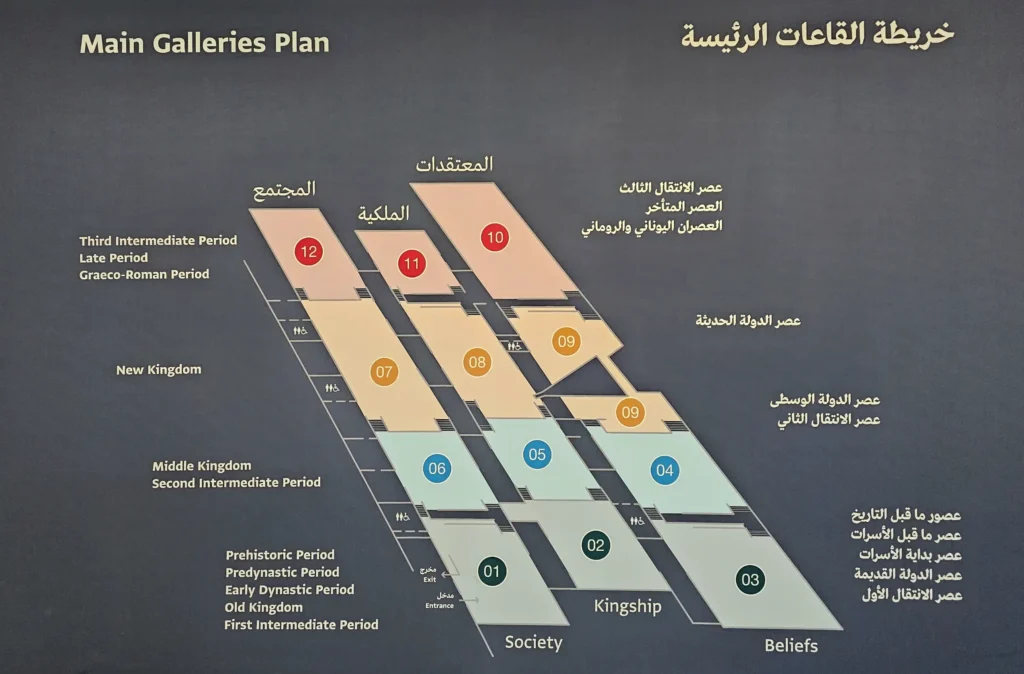
You can see this hidden-gem highlight of the Grand Egyptian Museum in Gallery 2, dedicated to Kingship in the earliest phase of Egypt’s history (map below).
2- Tel el-Farkha Golden Statues
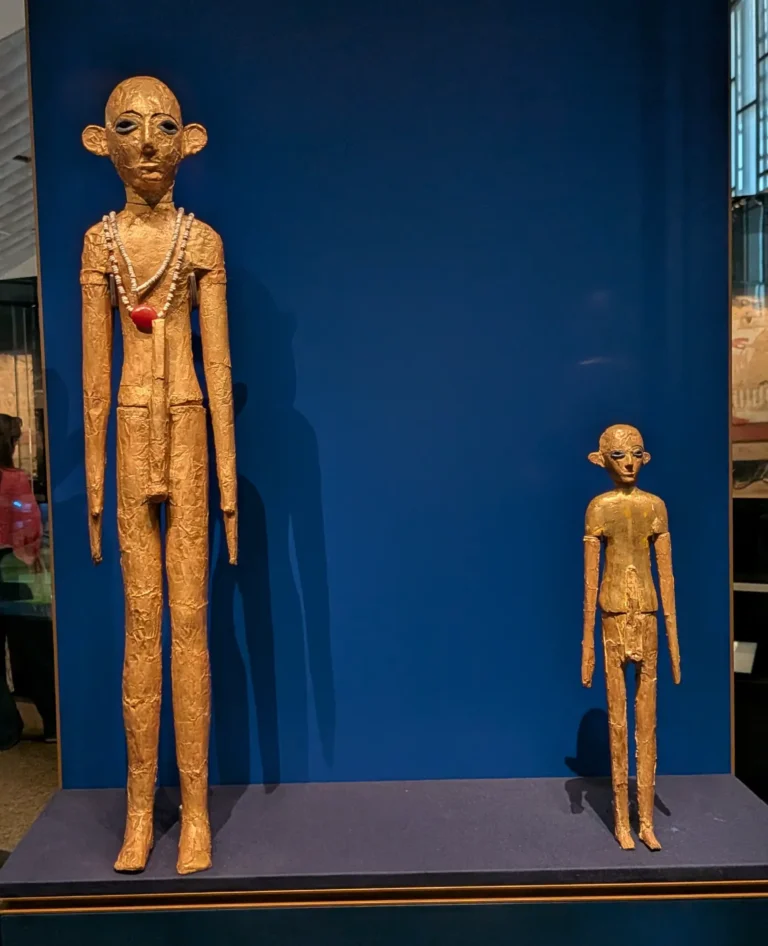
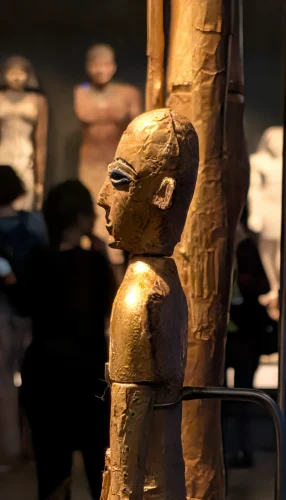
A few hundred years later, around ~3200 BCE, in the North of Egypt we also start to see social stratification and accumulation of wealth. The find of these two golden statues made this irrefutable. They were made out of wood covered in gold foil, and depict two very clearly male figures, with eyes inlaid with Lapis Lazuli. One is much larger than the other. The original wood was decayed when found, but conservators were able to reconstruct the gold foil’s original shape. They were discovered with a necklace made of ostrich eggshell and carnelian beads, and two large ceremonial flint knives.
They have been interpreted as an early proto-ruler and his son, or perhaps a person at two different stages in life, again giving us hints about the emergence of Kingship in Egypt. Tel el-Farkha was likely an important trade hub for items coming from the Levant, probably the source of wealth behind the creation of these statues. They were found in a building that had already been torn down when they were buried, perhaps hidden on purpose, and the Tel el-Farkha settlement eventually dwindled as trade routes and power shifted south toward Memphis, Egypt’s eventual capital near modern-day Cairo. You can read more about the site and the excavations here: https://pcma.uw.edu.pl/en/2019/01/14/tell-el-farkha/
The Tel el-Farkha statues are located in Gallery 1, that looks at society in the early part of Egypt’s history. These are a highlight of the Grand Egyptian Museum that are easy to find, the gold statues are beautifully displayed against a blue background, and now, beyond their beauty, you know why they are important. Only about 700 years after these statuettes were made, Ancient Egyptians were building the Pyramids of Giza!
3- Worker's Graffiti in Khufu's Solar Boat Pits
One of the key highlights of the Grand Egyptian Museum that no self-respecting tour guide would skip is the Solar Boat museum. However the hidden gem in this part of the museum is really easy to miss, but it is very important for showing that the Ancient Egyptians built the Pyramids!
King Khufu, the builder of the Great Pyramid, who lived around 2500 BCE, also had five boats buried around his pyramid, as we can see from the five boat-sized pits that have been found, two of which still contained the deconstructed boats. One of those has been reconstructed and is the star of the Solar Boat Museum.
Why boats in the desert? One or two of these boats might have been the actual vessels used to sail the King’s body to Giza to be buried, making them too sacred to be used again after. Others may have been interred so that the King’s soul could use them in the afterlife. Not all of the pits are the same shape and size, so it is possible that the boats buried there had different purposes.
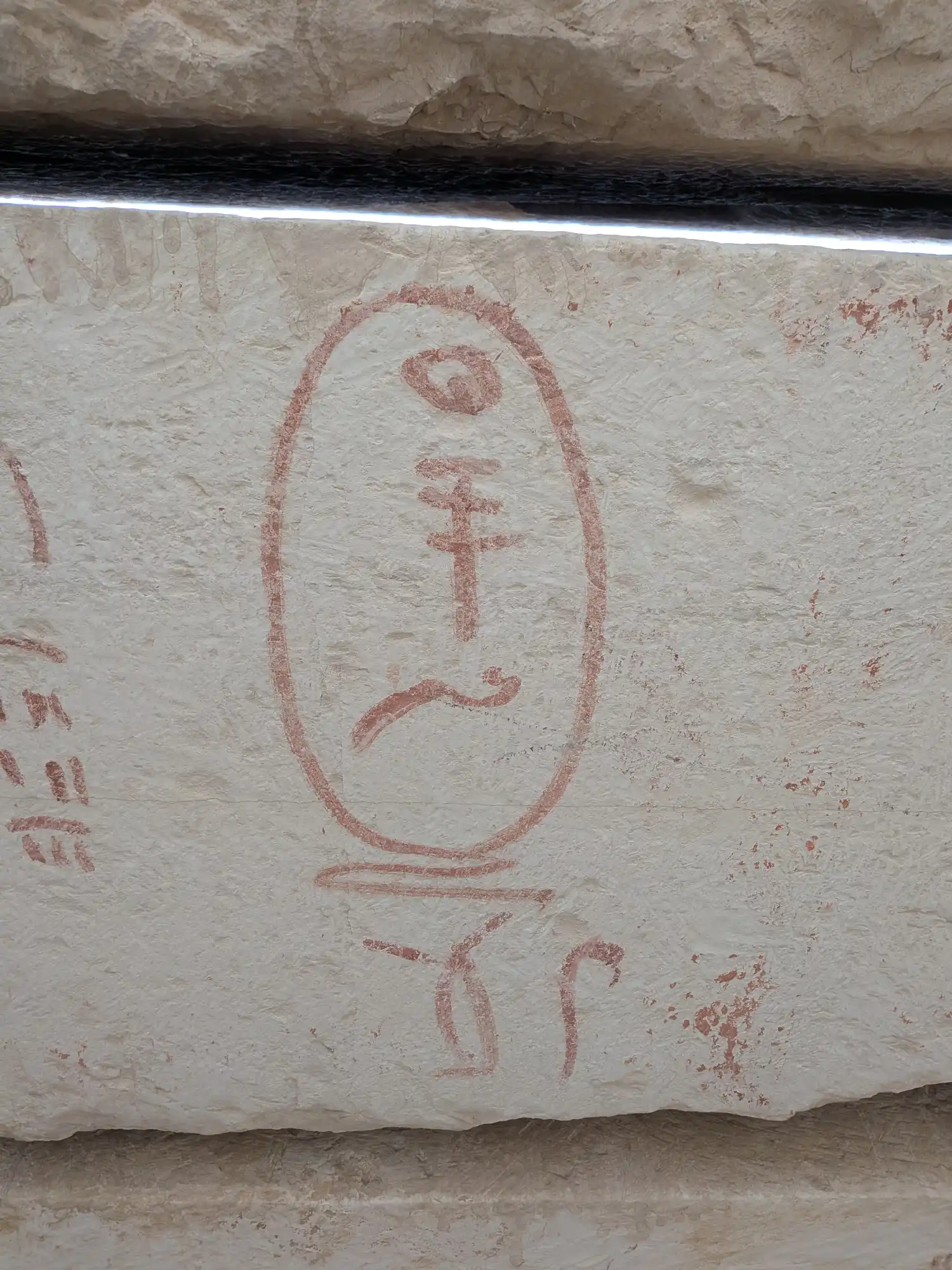
The name of the pharaoh Djedefre is contained within a cartouche in these "graffiti" left by the workmen who built the monuments on the Giza plateau.
Two of the boat pits were lined with limestone slabs, and spectacularly, some of the marks made by the workmen who built the pits and interred the boats, still remain on the limestone: bright red marks standing out in high contrast to the white limestone. Also called ‘graffiti’ they record the names of the work groups, measurements, and the cartouche (name) of King Djedefre, Khufu’s successor who would have been in charge of his burial. The presence of these humble marks of workers in the boat pits, in the limestone quarrying locations on the Giza plateau, and even in the pyramid itself, are some strong evidence showing that the pyramids were built by Ancient Egyptians, rather than aliens or lost civilizations as some internet celebrities would have you believe.
You can learn more about the excavation and ongoing conservation of the second solar boat here: https://jicagem.com/ or about excavations of the Giza plateau by the Ancient Egypt Research Associates https://aeraweb.org/, or about Giza’s excavation history via annotated digital reconstructions here: https://giza.fas.harvard.edu/
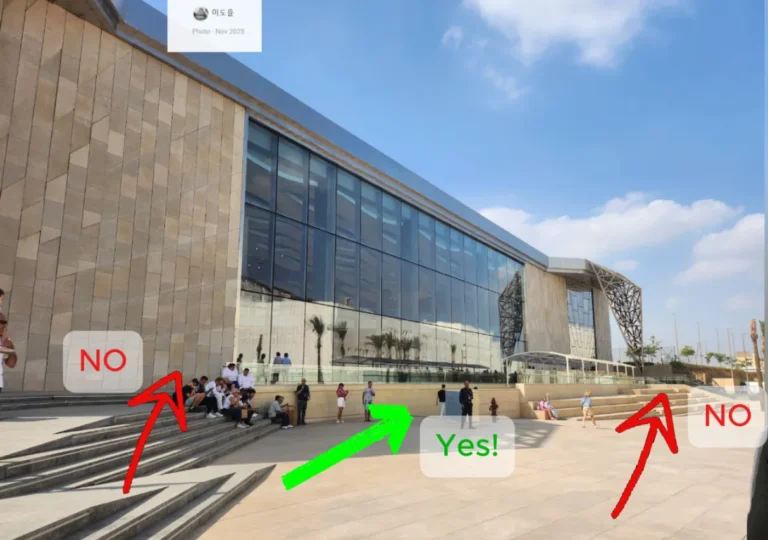
The limestone slabs of one of the boat pits has been moved and reconstructed in front of the boat museum. You can walk through it and look up at this graffiti for yourself! To find it you go out of the main museum and walk toward the boat museum, but don’t go up and around, go down and through!
There are three ways to get to the entrance of the Boat Museum from the main Grand Egyptian Museum building, but only one of them will take you through the reconstructed boat pit to find the workers' graffiti!
4- Early Evidence for Mummification: Queen Hetepheres' Canopic Chest
Staying with finds from the Giza plateau, the next highlight of the Grand Egyptian Museum that you should be sure to see is the tomb assemblage of Queen Hetepheres, especially her canopic chest. Alright, let me explain all that.
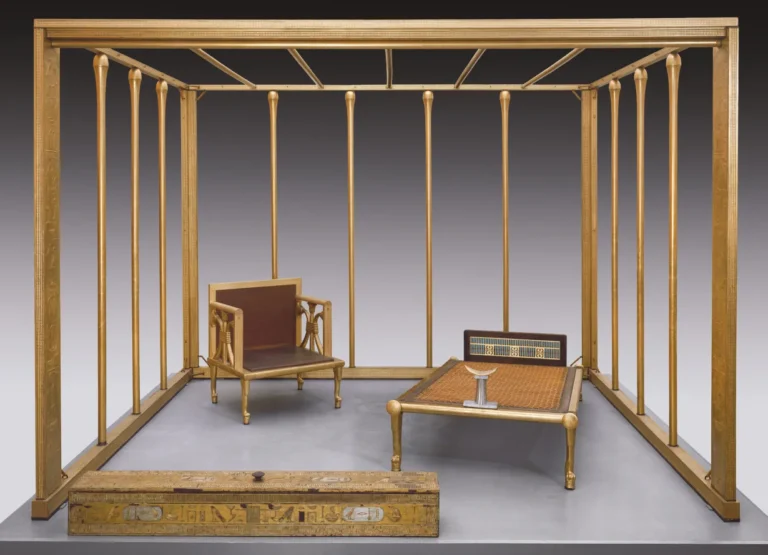
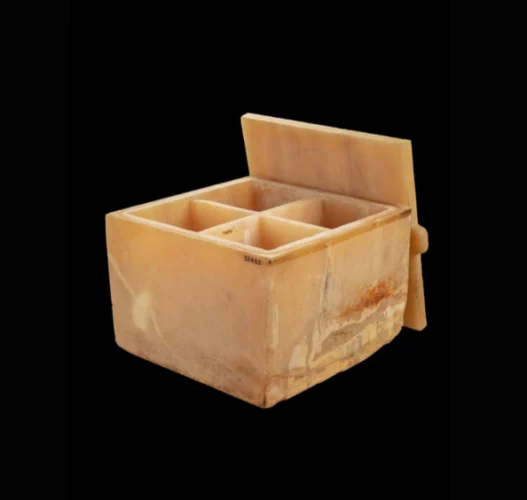
Queen Hetepheres was the mother of King Khufu. Her tomb assemblage was found in a burial shaft on the Giza plateau and includes a deconstructed bedroom set, jewelry, an alabaster sarcophagus, and a matching canopic chest. The bedroom set included a canopy, a bed, a headrest, and a carrying chair. It was all originally made of wood with gold leaf, like the Tel el-Farkha statues discussed above. And like those statues, what you see today is the original gold leaf and the reconstructed wood. The deposit also included a box of thick silver inlaid bracelets. Silver was more rare than gold in Egypt so these were really fit for a Queen.
Reconstruction of Hetepheres' bedroom set.
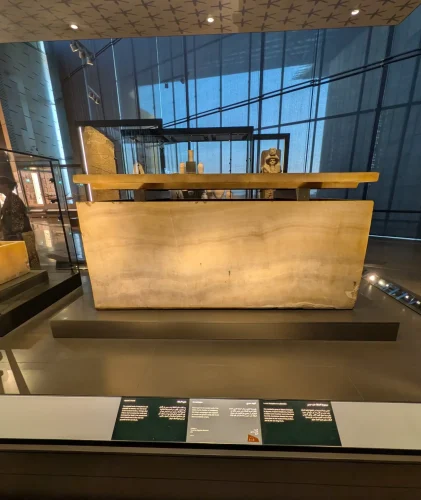
The sarcophagus is made of alabaster (also known as calcite), a beautiful somewhat translucent stone. The sarcophagus was found empty, which, along with other details of the architecture and finds, leads archaeologists to believe that the tomb assemblage was moved from its original location.
The bedroom set and sarcophagus are highlights of the museum, but the canopic chest is the hidden gem that is somewhat easier to overlook. A canopic chest or canopic jars are what we call the containers for organs removed from a body during the process of mummification. Organs needed to be taken out in order to help preserve the body- their soft tissue is too susceptible to decay. However they weren’t trash, they were also buried in the tomb with the body, just near it instead of inside it. Hetepheres’ canopic chest is the earliest one we have found and constitutes some of the first evidence for this practice. Mummification wasn’t invented overnight, it developed over time (in fact some of the earliest evidence we have for efforts to preserve the body comes from Hierakonpolis, over 1000 years earlier!). In contrast to the empty sarcophagus, when Hetepheres’ canopic chest was excavated in 1925 it still contained remains of salty water and organs.
You can find Hetepheres’ tomb assemblage in Gallery 2, the section on Kingship in the earliest phases of Ancient Egyptian History.
5- Osiris Sculpture: Earliest Archaeology & Myth of Osiris, Seth, Isis, and Horus
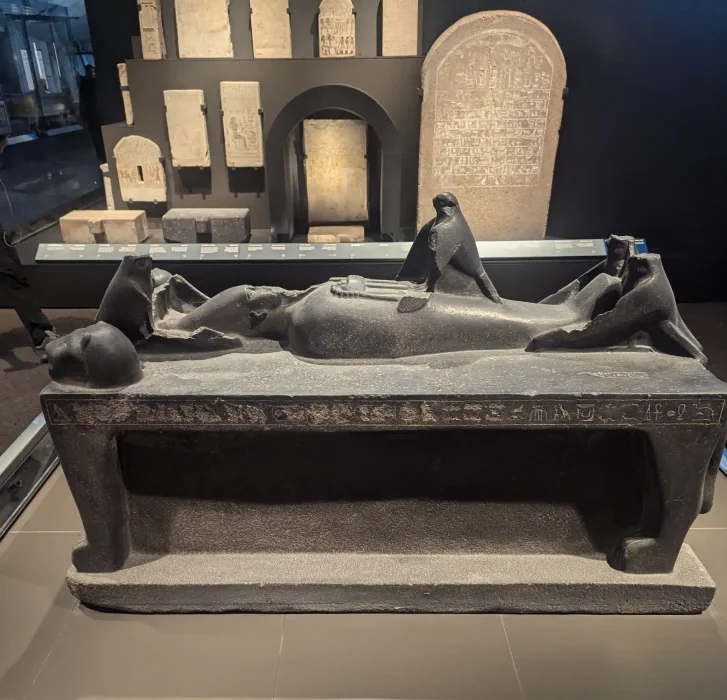
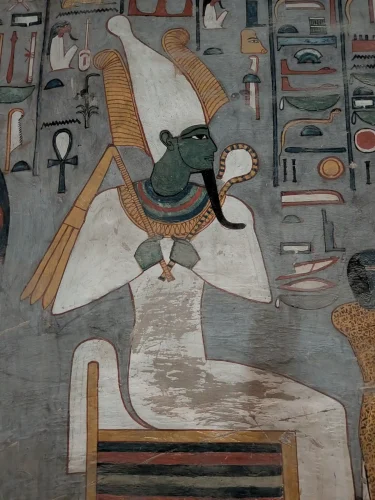
The last highlight you should not miss is a statue of the God Osiris laying on a funerary bed. This item dates to the Middle Kingdom period, ~2000-1650 BCE. However it was found in a tomb that dates almost a thousand years earlier! The site of Abydos is where the first Kings of Egypt were buried, around ~3000 BCE. But by the time of the Middle Kingdom, a thousand years later, their burial site was associated with Osiris. So the ancient Egyptians undertook what was probably the world’s first archaeology, and went and excavated some of those early royal tombs to figure out which one belonged to Osiris. They identified one as Osiris’ tomb (or at least representing Osiris’ tomb), and put this sculpture of Osiris inside it. The location became a pilgrimage site, with people coming from all over Egypt and leaving offerings.
This sculpture is also interesting because it represents a critical scene from the myth of how Osiris became the god of the afterlife and Horus became the god of Kingship. There are many versions of this tale, but the gist of it is that when Osiris was King, his brother Seth wanted to be King and killed him, cutting up his body and spreading it all over Egypt. Osiris’ wife Isis (who had some magical powers) collected the pieces of his body. She was able to find all the pieces except for one key piece needed to conceive a child. She created that last piece from mud and was able to magically revive Osiris long enough to conceive their son Horus, who eventually went on to defeat Seth, becoming the god of Kingship. This sculpture shows Osiris with Isis in the form of a bird, at the moment of conception.
The cemetery where this interesting sculpture was found continues to be a focus of archaeological research- this time modern. You can read about recent excavations of the tomb of Egypt’s first female ruler, Queen regent Meret-Neith, here.
If you make your own “pilgrimage” to the Grand Egyptian Museum in Cairo you can see this sculpture in Gallery 4, the section about beliefs in the Middle Kingdom Period.
What do you think?
Which of these hidden highlights are you most excited to see?
Are there other ones I missed?
Leave a comment below & stay tuned for more!
Want to Visit Egypt?
I love sharing Ancient Egypt with people by helping them visit Egypt! While I can’t take you to these sites in particular, I can help you plan an amazing trip, or you can join one of the curated small group tours that I lead. Find out more information here:
FAQ: Resources for Visiting the Grand Egyptian Museum
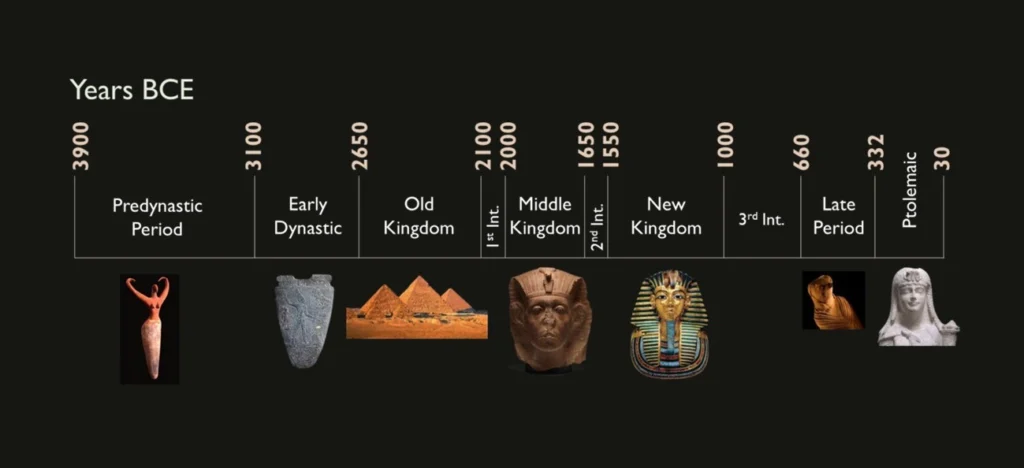
Ancient Egypt Timeline
Here is an overview of Ancient Egyptian chronology, the time periods of Ancient Egypt. Archaeologists and Egyptologists are always refining the chronology based on new dating methods, studies, and discoveries, but this gives you the general idea, so you can put these hidden gems into context.
Ancient Egypt Map
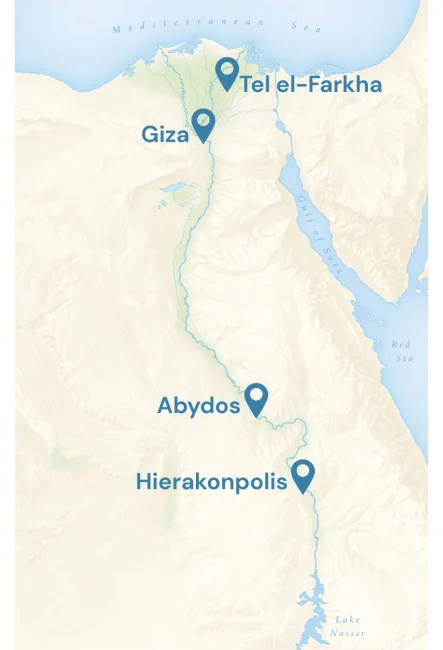
Archaeological sites mentioned in this post: Tel el-Farkha, Giza, Abydos, and Hierakonpolis.
Grand Egyptian Museum Maps
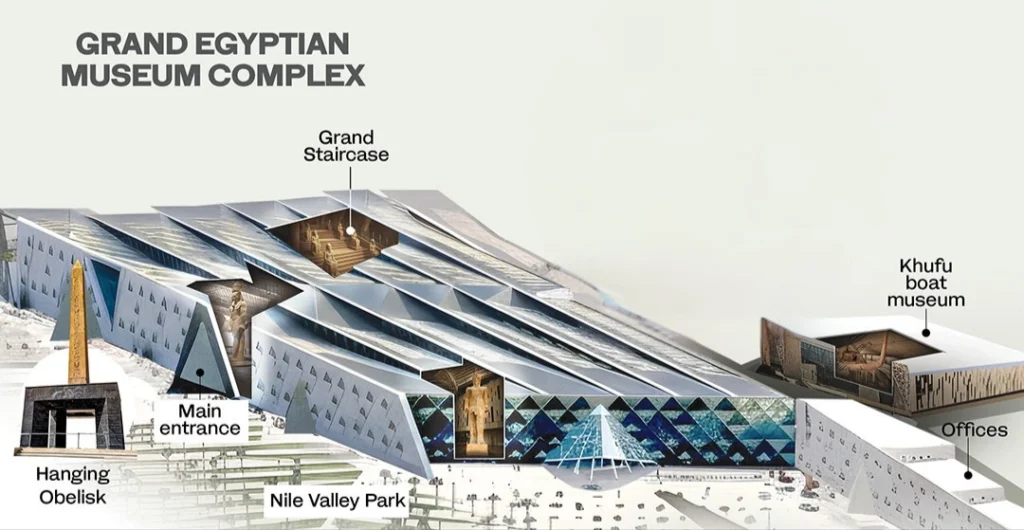
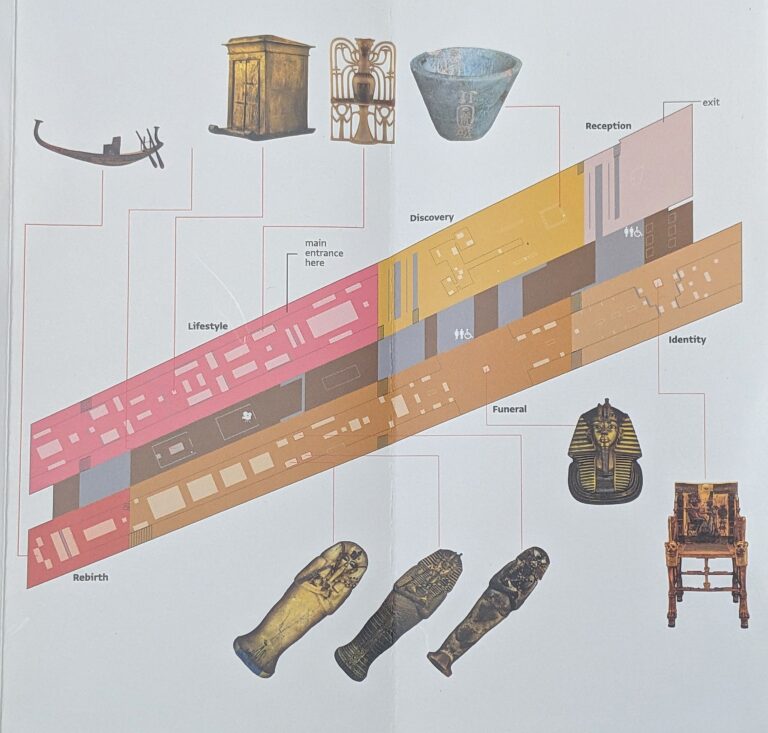
You really need three separate maps to navigate the Grand Egyptian Museum. It is very grand after all.
Once you go through the main entrance hall, at the end of it to the left you will find the grand staircase. You can walk up it or take an escalator. At the top if you turn to the left you will find the main galleries. They are organized very logically, sections dedicated to Society, Kingship and Beliefs. Progressing along each section takes you from the earliest periods to the latest. Depending on how you move through the rooms you can explore a theme or a time period. However in practice it is very easy to get turned around, so it is a good idea to carry a map with you!
Tutankhamun Galleries Map
At the top of the Grand staircase if you turn right you will enter the Tutankhamun Galleries. As of early 2026, you weren’t allowed to enter there, but had to go through the main galleries and take a cross walk over from room 7 of the main galleries into the Tutankhamun section. This is kind of a shame because you enter in the middle of his collection, instead of starting with the highlights and the mask.
Grand Egyptian Museum Ticket Price
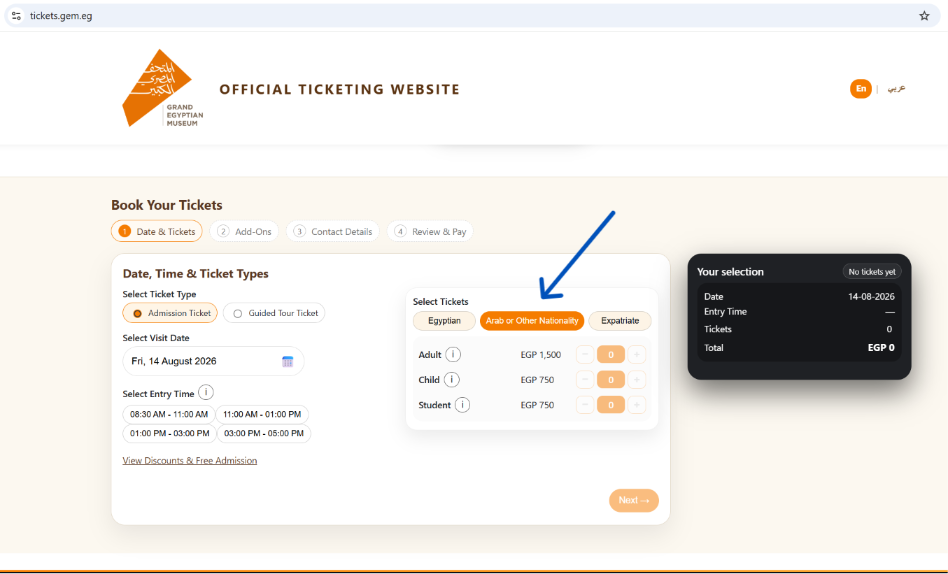
You can buy tickets to the Grand Egyptian museum ahead of time online at tickets.gem.eg.
There are different prices depending on whether you are an Egyptian citizen, an Expatriate living in Egypt, or are a citizen/resident of another country. The names of the categories are a little confusing. Most people visiting Egypt from another country should choose the category “Arab or other Nationality“. The ticket price for this category is 1,500 Egyptian Pounds, or about $29 US dollars (as of late July 2026).
They ask you to select a general timeslot for entry (there are four throughout the day), but in my experience it isn’t too strictly enforced, which is a good thing given the traffic in Cairo!
Grand Egyptian Museum Opening Hours
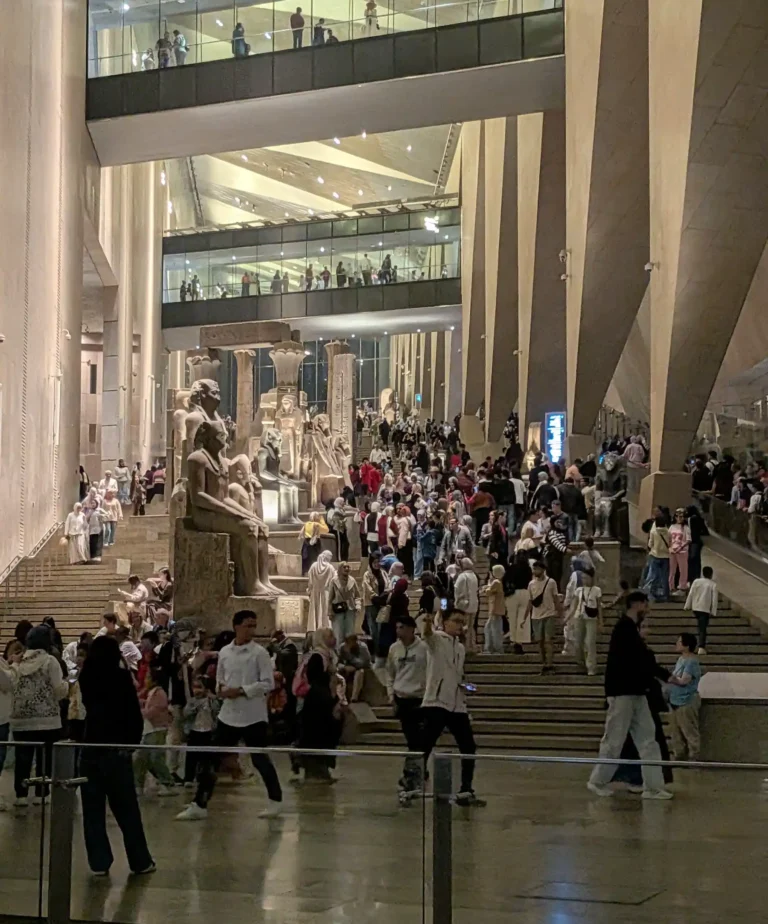
The official opening hours of the grand Egyptian Museum are daily from 9am to 6pm, with extended hours until 9 pm on Wednesdays and Saturdays. However sometimes they will extend hours on the weekend evenings (Thursday / Friday in Egypt) if there is a lot of demand. This happened to me when I visited on a Thursday in November 2025, and I got a few unexpected bonus hours! It does get pretty busy on Fridays and Saturdays, so if you have some flexibility in your schedule, try to go on a Sunday-Thursday.
The Grand Egyptian Museum Grand Staircase on a busy Thursday night.